Information
- Location
- Kyzylorda Region, Kazaly District
- Period
- 901 – 1100
- Category
- Historical and cultural monuments of republican significance
- Type
- Tower
- Kind
- Buildings of monumental art
Sources
- Қазақстанның киелі орындарының географиясы: Табиғат, археология, этнография және діни сәулет өнері нысандарының тізілімі / Жалпы редакциясын басқарған ҚР ҰҒА академигі Байтанаев Б.Ә. – Алматы: Ә.Х. Марғұлан атындағы Археология институты, 2017. – 1-шығарылым. – 904 б.
Description
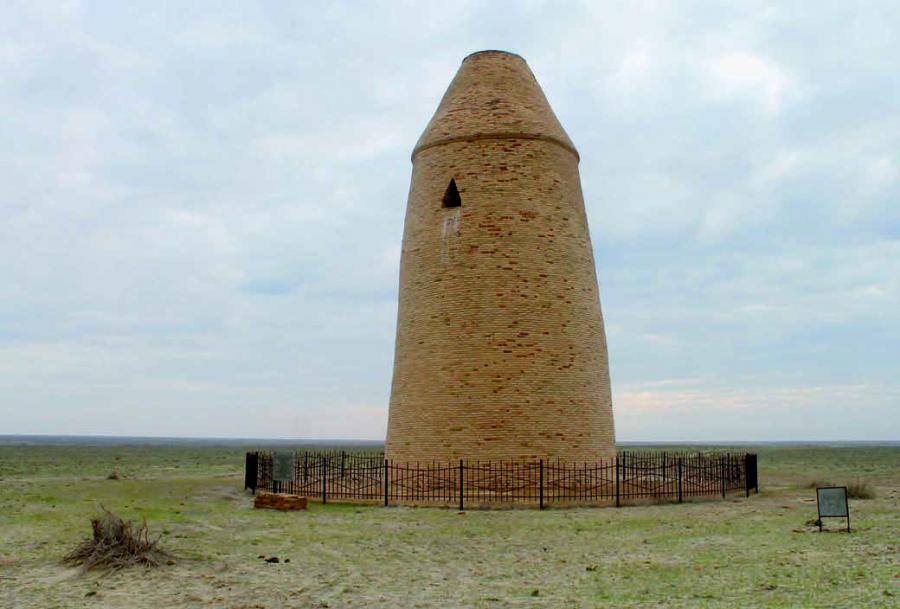
The tower is located 3 km east of the village of Kaukei (Kazaly district, Kyzylorda region). The towers located in the lower reaches of the Syr Darya River are left in different periods. The first, dated to the IX-XII centuries, includes monuments of Uzuntam, Begiman, Saraman-Kosa, i.e. towers of the Oghuz-Kypchak era. By the second period - towers of the end of the XVIII - beginning of the XX century.
On the history of creation of the tower there is a beautiful legend, according to which Saraman - the son of the khan, who ruled the city of Zhent, and poor guy Kosai were friends. Two friends, in order to see the world, having asked for permission of the khan and crossed the rivers Kuandarya and Syr Darya, moved further towards the Arch. One day, on the bank of the Taldysai River, flowing out of a small mountain Tasbulak, friends got to the big toy (bowl), arranged to marry the girl. Wrapped up in her infancy for the rich man's son, the girl looks at Saraman with her eyes, and they, having understood each other without words, took a moment, met and agreed to run together. The three fugitives rode at night until the horses were tired, rested during the day and thus went to the Syr Darya on the sixth day. They crossed the Sagyr River to swim on horses and stayed overnight when they got to Kuan. The next day, before reaching the hill, where the monument is now standing, they saw those who chased them. Saraman, realizing that he would not be able to escape, nevertheless did not consider it right to drive into the city, though he was nearby: the pursuers may lead an army and a real war will begin, or if they go after them in the city, may suffer themselves. So Saraman decided: "Than we will give away the sin of killing us to others, it is better to ourselves. I will stop them. Kosai, you with the girl go to Kyzylkum. If I stay alive, I will find you. Then Kosai replied, "What good is my friendship to me if I am not your victim. It's my business, by all the rules. So, don't be late". But Saraman did not agree. Those who caught up to it were superior in number: six brothers of a girl with twenty dzhigits. Having overcome seven men, Saraman was finally captured. The girl and Kosai did not leave the battlefield. Then Kosai, looking from the height of the hill and realizing that the battle would not end, said to the girl: "You run in this direction. You'll be alive, don't forget - there's a town called Zhent behind the hill where the battle took place. Saraman's family lives there. The girl thought, "I'm wearing mourning clothes (widowed), how I'm going to go to his relatives," and stayed there. Kosai entered the battle, the friends were defeated: the opponents beheaded both Kosai and the girl. By order of the khan each of them was buried there, where they found their death, and on that place they built a tower.
The height of the tower is about 15 m, the diameter of the base is about 5 m, it is three-tier. The inner part is made of mud, the outer part of it is made of burnt square bricks with ideal masonry. In general, a solid masonry of 206 rows can be traced. There are two types of bricks, one of which has the size of 20×20×5 cm. In the upper part of the tower there are three openings for observation, the entrance is directed to the south-west, two-chamber, inside there is a spiral staircase.
The Saraman-Kosa Tower is an ancient monument erected presumably in the XI century. It belongs to a number of historical and cultural monuments of national importance. The object was registered and documented by the "Kazprojectrestoration" scientific research institute in 1986.
The sacral nature of the object is justified by the fact that the legendary motif, known among the people, formed the basis of the history of the tower construction.