Information
- Location
- Kyzylorda Region, Karmakshy District
- Period
- 1801 – 1900
- Type
- Mausoleum
- Kind
- Buildings of monumental art
- Authors
- Тажекеев Әзілхан Әуезханұлы
Sources
- Қазақстанның киелі орындарының географиясы: Табиғат, археология, этнография және діни сәулет өнері нысандарының тізілімі / Жалпы редакциясын басқарған ҚР ҰҒА академигі Байтанаев Б.Ә. – Алматы: Ә.Х. Марғұлан атындағы Археология институты, 2017. – 1-шығарылым. – 904 б.
Description
It is located 18 km east of the village of Zhosaly (Karmakshy district, Kyzylorda region).
Maral Ishaan Kurmanuly (1769-1841) was the main imam of Western Siberia, but in 1807 due to the strengthening of the colonial policy of tsarist Russia became one of the organizers of the armed resistance.
Maral is a direct relative of Kenesary Kassymuly's mother. He supported the national liberation movement of the Khan. Maral was a visionary, predicting some events. His father Kurman Kenzhebayuly was a batyr and healer of Abylai Khan. In 1741 Dzungarian Huntaiji Khan Abylai led a small detachment of 200 men and fiercely resisted the Dzungars, but the army was defeated and the khan was captured. According to historians, the commandant of the Yamyshevskiy bank wrote about it in his memo to the office of the Siberian province. In the course of negotiations, Galdan-Tseren and Abylai Khan reached an agreement. Huntaiji freed Khan Abylai, and two of his daughters from his Kazakh wife, whom he gave to Abylai, became the pledge of a truce between them. Abylai Khan gave one of them, Fatima, to his faithful companion Kurman as his wife. Maral Ishaan was born of this marriage in Kairankol near Kyzylzhar (now Kostanay region). When his father died, the boy was nine years old and had to drink the bitter cup of orphanhood in full. Together with his mother in search of a better life at the age of 13, Maral found himself in the vicinity of the fortress of Akmeshit. He dreamed of studying, but because of the need he had to hire help for Kulanbai Ishaan. A man rich and with an open mind, Kulanbai Ishaan was able to recognize the extraordinary abilities of a teenager.
In 50 km to the east of Bukhara and 70 km from Kattakurgan of Uzbekistan in the cave of Mount Zham there lived a holy seer and a scientist Zhalanayak Ishaan, who opened a madrassa there and taught children. Kulanbai sent the young man to him, blessing him and promising to marry his daughter. The diligent and inquisitive Maral became the best disciple in the madrassa. During one of his visits to Akmeshit, he married the daughter of Kulanbai Ishaan Menlibike. Maral Ishaan studied at the madrassa for 10 years and received a wonderful religious education at that time. At the end of XIX - beginning of XX centuries in spiritual life of peoples of Central Asia, including Kazakhs of Turkestan region, the big role was played by Ishaans as conductors of Muslim religion, enlightenment, national traditions of healing, national psychology and ideology.
Maral Ishaan had great authority among the population. Already in his lifetime he was revered as a saint and healer. A spiritual ally of Kenesary Khan, he was a progressive public figure, and called on his relatives to stop inter-clan relations, to move to a settled way of life, to master literacy and crafts. In honor of Maral Ishaan, famous akynas of the past Balkan Bazaar, Omar Shorayak, and Turmagambet were folded in their time. Maral Ishaan passed away at the age of 61 during a trip to his native places. According to his will, he was buried in Karmakshy land. Not far from the mausoleum his eldest son Kalkai Ishaan, grandsons of Ospan Ishaan, Tobagabyl Ishaan, Kaus Ishaan and Amit Ishaan rest. All of them were preachers of Islam and left behind scientific works that played an important role in familiarizing the local population with the humanistic traditions of one of the world religions.
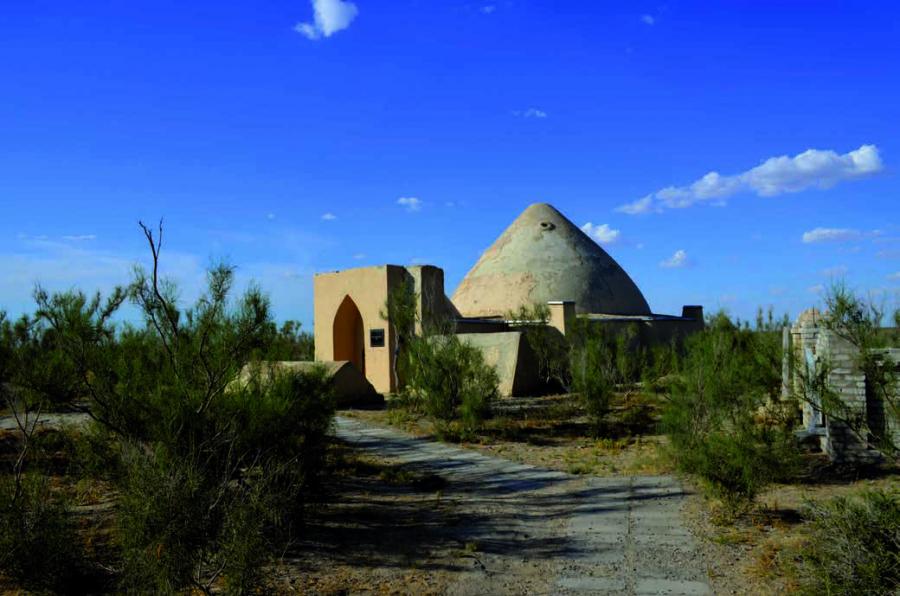
Maral Ishaan's mausoleum is made of mud brick of rectangular shape on clay mortar. The mausoleum is a two-chamber mausoleum (funeral and entrance) with longitudinal-axial arrangement of the chambers inscribed in the prismatic building. The plans of the mausoleum of the first and second rooms are close to the square. Their dimensions from the inside are 6.0×5.8 m for the first and 2.8×2.8 m for the second. The height of the mausoleum walls is 2.3 m and the height of the portal is 3.5 m.
The main facade of the mausoleum is oriented to the south-east. The portal has a lancet niche, in the depth of which is the entrance to the mausoleum with a two-leaf wooden door. The facade planes are enlivened by rectangular pedestals, pilasters of semi-circular shapes and small niches. Domes of the room of the spherical-conical form are based on a circle of light drums. Transition from a rectangle to a circle is executed by means of angular sails. Further by means of an ordinal admission of a bricklaying transition to a dome is carried out.
The mausoleum is unique in its architectural features, in addition, it is the most monumental raw mausoleum in the lower reaches of the Syr Darya River. Preservation of monuments shows traditional for Kazakh people respect, memory, and respect for the burials of ancestors who dedicated their lives to serving the people, protection from invaders, and enlightenment.