Information
- Location
- Kyzylorda Region, Karmakshy District
- Period
- 1001 – 1100
- Category
- Historical and cultural monuments of republican significance
- Type
- Сomplex
- Kind
- Ensembles and complexes, Buildings of monumental art
Sources
- Қазақстанның киелі орындарының географиясы: Табиғат, археология, этнография және діни сәулет өнері нысандарының тізілімі / Жалпы редакциясын басқарған ҚР ҰҒА академигі Байтанаев Б.Ә. – Алматы: Ә.Х. Марғұлан атындағы Археология институты, 2017. – 1-шығарылым. – 904 б.
Description
It is located 18 km north-west of the village of Zhosaly (Karmakshy district, Kyzylorda region).
Korkyt ata is a historical personality, poet-zhyrau, "the owner of a kobyz". The cult of Korkyt ata, which has a thousand-year tradition and is associated with the migration of Oghuz tribes, was spread over a vast area of the Eurasian steppes among the Turkic-speaking peoples and was reflected in the spiritual culture of the Kazakh people. The time of his life is not precisely determined, and legends and scientific researches define him unequivocally. Most people agree that Korkyt-ata lived near the Syr Darya River, and in the Oghuz-Kypchak tribal union in the X c. A.Kh. Margulan in his works considered the time of Korkyt-ata's life in the VII-VIII c. A. Konyratbayev on the basis of oral folk tales and written sources came to the conclusion that he died by the beginning of the XI c.
Korkyt ata - the first shaman, the creator of the kobyz.
According to legends, Korkyt ata is a storyteller, musician, akyn, author of epics, founder of Kazakh string and bowed music. Korkyt-ata epics are considered to be the beginning of steppe poetry; his kuis are the only spiritual, moral, cultural and historical wealth of Kazakhs. But after the adoption of Islam in the steppe, many works have lost their original appearance. There are legends about the personality of Korkyt - he was invulnerable, even a diamond sword could not kill him; Korkyt ata protected children from diseases, according to a widespread legend among the Kypchaks, Korkyt ata called newborns. The people gave him three names: "Baba", "Pir", "Yer". The tales of Korkyt ata, its philosophical reflections have found reflection in representations of Turkic peoples about life and death. Once Korkyt ata, falling asleep, heard the words: "If you do not remember about death, you will live forever. After a while he couldn't get to one path and said: "Even if I die, I will come! According to another version, Korkyt was playing the kobyz and saw how the bull got out of the harness, but couldn't catch up to bring him back. And he said these words in a bitter way, regretting it. In search of eternal life, escaping from death, Korkyt ata on his camel Zhelmaya went around the world, but realizing that death is inevitable, returned to his native places, the delta of the river Syr.
According to another legend, he put the carpet in the middle of the river and decided to swim along the Syr Darya River. Thinking that eternal life is an art, Korkyt created a kobyz. Korkyt ata played the kobyz, the carpet did not sink into the water. As long as the kobyz sounded, everything froze, the wind stopped, the birds did not fly, and death, which was not in control of life and music, could not catch up Korkyt ata. He sailed for a long time, but when he was tired and fell asleep, a snake came out of the water and bit him poisoning him. This legend reflects a philosophical view of death, a problem of time and space. "The legend of Korkyt is deeply optimistic, and its meaning is that Korkyt found immortality in the service to mankind by the art he created" [Valikhanov, 1961].
One of the numerous variants of the legend "Kyryk Kyz" ("Forty Girls"), which is widespread in Turkic culture, is also connected with the name of Korkyt, having acquired a deep philosophical meaning. The magical sounds of kobyz forced people to go in search of the source of sound. So 40 girls went on a long journey to see Korkyt. On the way 39 of them died, only one of them managed to get to Korkyt. Aksak kyz (the Lame Maiden), having passed through all obstacles, has seen Korkyt and has collapsed without feelings. In different variants she brings a musical instrument to our world "from the zone of death", on the other hand she brings death to Korkyt.
Korkyt ata traveled on his famous camel Zhelmaya, which possessed magic power. A camel of noble blood "tau tailak" was presented to him by Kypchaks, who were relatives on the mother's side. These animals served the people who lived between the Aral and Caspian Sea, a reliable means of transportation, were distinguished by extraordinary endurance. The camel grew up not recognizing strangers, but loyal to his master. Korkyt ata on his camel could overcome any obstacles, it jumped faster than a flying eagle, like a bird, flew across the ocean.
In the legends that have survived to our times, the name of Korkyt is met in connection with the history of the city of Zhankent. About it A.Kh. Margulan wrote that in the Kazakh legends the data on destruction of the ancient settlement of Zhankent, on mass death of people caused by a cluster of poisonous snakes were postponed. Notable people of the city - Korkyt ata, Sarmankus, Sultan Sannak, his wife Bikem, their parents, children and many relatives - died of snake bite. In difficult moments, the spirit of Korkyt appears to preserve Zhankent - a black storm falls on the land of Syr.
The birth of Korkyt was unusual. There is a legend that originally his name sounded like "Korkyt" (fear). The woman wore a son for three years and nine days. When the time came for the child to be born, a storm came up, accompanied by a thunderstorm. It became dark around. In addition, the child, barely born, immediately started talking. These phenomena scared people so much that the child was given the name Korkyt. The song about the miracle of Korkyt's birth has been preserved and mentioned by A.Kh. Margulan:
When Korkyt was born,
The black sky was flooded with water.
When he was born, the country was scared
And it was happy afterwards.
Considering the etymology of the word "Korkyt", A. Konyratbayev interprets it as "bringing good to mankind", and S. Kaskabasov sees the meaning of the word differently - "a man died, the end of life". Е. Tursynov, studying the folklore of Turkic peoples, came to the conclusion about the meaning of "poet-improviser". V. Zhirmunsky supposes in Korkyt "a shaman, a master having a magic power of a kobyz". Korkyt ata was first mentioned in his works by the Arab researcher al-Istahri. Traveling in the delta of the Syr River in Khorezm, he recorded a legend about two thinkers, which the Turks had always had: Barzu is a legendary healer and Korkyt-ata is an improviser-composer, thinker, patron of baksy.
Korkyt dreamed of an alliance of Turkic peoples, strengthening of Oghuz tribes and creation of a strong state. Korkyt as a historical personality is evidenced by a written source - the all-Turkic epic "Kitabi dedem Korkyt" ("The Book of My Grandfather Korkyt"). There Korkyt appears as a wise man, shaman, poet, philosopher and great performer of the Kuis. His sayings can be regarded as messages to the people, they are filled with deep meaning: "Where life, there and death, life does not happen without end, even iron bent, everything changes in another form, forgotten. Only eternally in memory remains the result of a good deed".
For Kazakhs, as well as all Turkic ethnoses, the name Korkyt-ata is connected with the statement of fundamental, basic ethical values. His life is an example of eternal search of spiritual and philosophical foundations by a man.
Korkyt-ata tried to overcome, to defeat death, to find the true value of human being, human life. Korkyt-ata has overcome death, becoming immortal in the memory of the people, found immortality in service to people, in the works of art created by him. The wanderer of the Great Steppe achieved his goal. "Korkyt in his lonely torments hollowed out of shirgai wood - the first kobyz, pulled strings on it and played, pouring out his agonizing thoughts and feelings. He put his whole soul into these melodies, and the wonderful sounds of his strings sounded all over the world, reached people, captured and captivated them. Since then, the melodies of Korkyt and the kobyz created by him went to wander the earth, and the name of Korkyt remained immortal in the strings of kobyz and in the hearts of people" [quoted from: Auezov, Sobolev, 1961]. In Soviet times, the study of life and work of Korkyt ata was carried out by famous scientists - A. Divayev, M. Auezov, A. Margulan, A. Konyratbayev, M. Baidildaev and others.
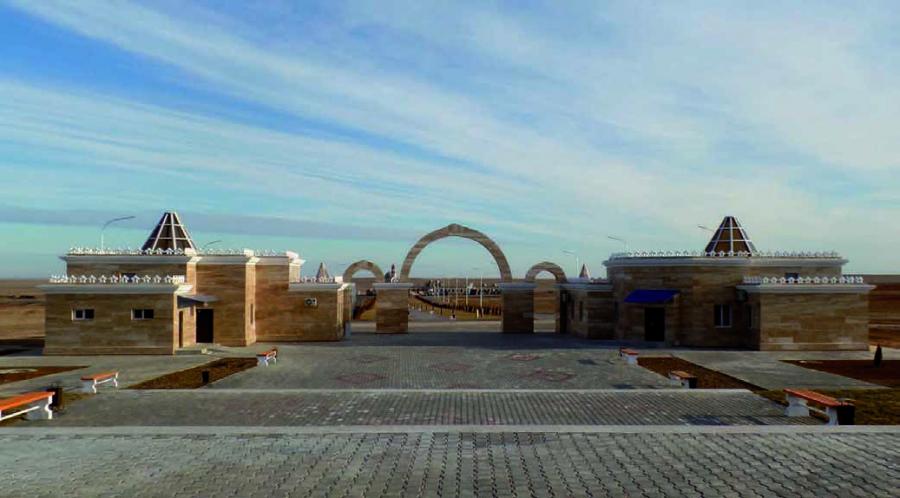
Mazar of Korkyt was originally built in 3 km from the modern station Korkyt (Karmakshy district) at the end of the XIX century. The monument was noticed by A. Divayev and I.A. Kastanye. The first photo of the mazar was published by A. Divaev and I. Kastanye. Divaev in the album "Turkestan" with a description: "...built of mud brick, has a round shape, with a 6-8-migrant dome". The memorial complex is an example of ancient architecture and a holy place for Turkic-speaking peoples. The construction of the memorial complex began in 1980. The complex consists of several monuments. The authors of the project are well-known architects B.A. Ibraev, S.I. Isataev. In 1997, restoration works were carried out. The architectural ensemble was supplemented by an amphitheatre, a hotel and other objects.
By 2000, the construction of a complex comprising a small administration building and a museum of history and culture of the era of Korkyt ata had been completed. The complex provides services as a branch of the regional museum. In 2014, restoration works were carried out at the expense of the regional budget. The monument is based on a large-size kobyz. Pipes with a wide opening were installed in the upper part of the monument. The monument consists of four vertical elements - steles with sockets at the top of the monument, 8 m high. Each stela is oriented on the sides of the world. There, where sockets converge, there is an organ from 40 metal pipes. In the wind, it makes sounds that resemble the sound of kobyz. The pointed vault inside the monument is decorated with the ornament "tuye taban" ("camel trace") symbolizing the camel of Korkyt Zhelmaya.
The complex includes a number of components. Among them is a sculptural image of the ram, 165.5 cm long, 85 cm wide and 120 cm high. It is made of Korday granite. Hilluet - The Pyramid of Wishes is a place for religious rites by dervishes, followers of the teachings or a basement for requests and appeals. Amphitheatre - built in the traditions of building architecture. In the middle of the amphitheatre there is a round arena. The seats of the audience are made in the form of a closed circle, a staircase rising upwards. Amphitheatre dimensions: 536 m2, lower diameter - 6 m, upper diameter - 25 m. The museum consists of three exhibition halls. It contains valuable exhibits and materials of history and culture of the Korkyt era. More than 700 exhibits are kept in the museum's collection.