Information
- Location
- Kyzylorda Region, Zhanakorgan District
- Period
- 1850 – 1900
- Category
- Historical and cultural monuments of republican significance
- Type
- Mausoleum
- Kind
- Buildings of monumental art
Sources
- Қазақстанның киелі орындарының географиясы: Табиғат, археология, этнография және діни сәулет өнері нысандарының тізілімі / Жалпы редакциясын басқарған ҚР ҰҒА академигі Байтанаев Б.Ә. – Алматы: Ә.Х. Марғұлан атындағы Археология институты, 2017. – 1-шығарылым. – 904 б.
Description
Located 20 km southwest of the village Zhanaryk, 35 km from Zhanakorgan in Kyzylorda region. The mausoleum was erected in honor of Batyr Korasan ata, one of the legendary educators.
Korasan ata was from descendants of Imam Hasan, son of Ali (son-in-law of Magomet). His real name was Abdulzalil, and Korasan was only "Lakab" - a nickname, a title. As an expert in Kazakh monuments I.A. Kastanye noted, he was so called because he treated smallpox (korasan): if he stepped over the head of a patient, the disease in that person proceeded in a mild form (bes konak), the patient quickly recovered [Kastanye, 1910, p. 207].
The Korasan ata was considered to be one of the first to bring Arabs to Central Asia, to the land of Turks and Kazakhs, in particular to the land of Syr, the religion and culture of Islam. Korasan ata is a descendant of the Prophet Muhammad. According to the genealogy, the sixth great-grandfather of the Korasan ata, Aziret Ali and the Prophet Muhammad, had kinship ties in the third generation. The father of the Prophet Muhammad, Abdilda, and the father of Aziret Ali, Abutalip, were two brothers. Their father was Abdumutalip. This legendary man lived approximately in the VIII-IX centuries. Korasan ata is known as a great enlightener of the people who opened several schools. According to the legend, in one of them he read namaz in memory of outstanding teacher Khoja Ahmed Yasawi in the days of oraza and Eid al-Adha. The expression "Grandfather Khorasan, the arasan came" is known, which reflects the glory of him as a skilled healer.
The complex with the mausoleum includes a copy of the Kaaba and a well, the water of which is considered holy. There is a legend about how a copy of the Kaaba appeared. Korasan ata had a son Husain-Gazi. According to legends, he was called Gazi because he became famous in battles with the Kalmyks. It is believed that Husain could not be hurt by a spear, a rifle or a sword. The Kalmyks, wishing to kill Husain-Gazi, cunningly found out from his wife that during the morning prayer he lost his strength for a while. During the morning prayer in the mosque, Husain-Gazi was killed by the sword. People going to the grave of Korasan ata, first pray over the grave of Husain-Gazi, because so ordered during the life Korasan ata, considering his son above himself.
Korasan ata read morning prayer (Sunnat) in his mosque, and farz - in Mecca. Once Husain-Gazi asked him: "You are not there during the Farz, where do you go then?" He replied that the farz "he commits in Kaaba".
The son said: "Wouldn't it be better for the Kaaba to bring it here than to go there with so much difficulty?" Father replied that it was not in his power. Then the son asked his father for permission to pray to God and move the Kaaba (from Mecca) here. His father allowed, and during the morning prayer of Husain-Gazi Kaaba ran through the sky and stopped over the Korasan ata. When the father saw this, he realized that his son was a saint, and outlined on the ground the places covered with the shadow of the Kaaba, and sent the Kaaba back to Mecca.
After the death of Korasan ata, the grateful people erected a barrow over his grave. Later a mosque was built here. Destroyed during the Soviet era, the mausoleum was revived with the independence of Kazakhstan.
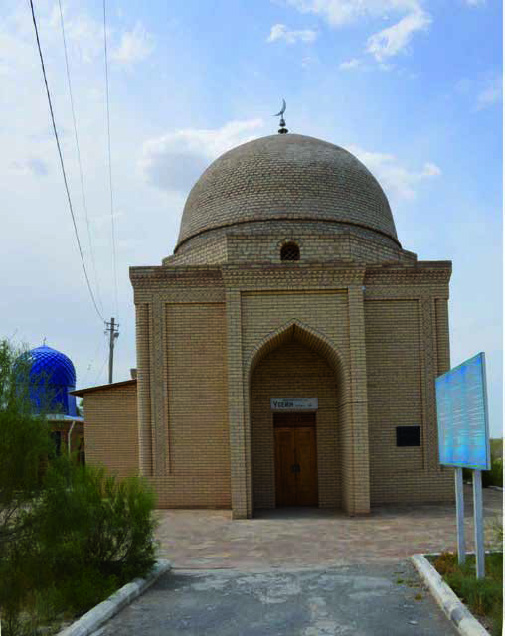
The mausoleum of Korasan ata with its variously large domes of graceful outlines is designed for external perception. The object is located on an elevation and is dominant not only on the necropolis, but also on the surrounding plain for many kilometers. The mausoleum was built of rectangular bricks (7×14×28 cm). It included two chambers inscribed in the prismatic body of the chamber: a small one and a large one with separate entrances. The chambers were covered with small and large spherical-conical domes on dome drums. The height of the mausoleum is 14 m, length - 16 m, width - 8 m.
The dome drum of the small chamber is round in plan, the big chamber is octahedral, these drums have easy narrowing upwards, but nevertheless in diameter they are more than the bases of domes. The chambers have separate entrances - the entrance to the small chamber is oriented to the south-east and marked by a special actively extended portal, while the entrance to the large chamber goes to the south-west and is solved in the form of a small room.
The portal of the small chamber is unique: it is hypertrophied, but it does not rise above the roof of the mausoleum and is more like a wide vaulted corridor. This unites the mausoleum with the so-called "Dahistani" group, whose deep and low portals are linked by researchers to pre-Muslim nomadic peoples' traditions. The room in front of the entrance to the big chamber - tilauhana - is intended for ritual sleep, it is also the same height as the roof of the mausoleum, but has no overlap. The roof of the mausoleum is crowned with a cornice with brick brackets, but only over a small chamber.
Each of the four walls of the small chamber has a large arch niche, the transition to the dome circle takes place gradually by filling the masonry over the corner arched trumpets. This part of the masonry is hidden from the outside by a dome drum, where four arched openings are arranged on the longitudinal and transverse axes. Structures of transition to the circle of the dome in the big chamber are different - these are the sails formed by letting in the masonry from the corners of the chamber at an angle of 45 ° to the walls. Gradual transition to the circle of the dome occurs slightly above this octagon. The camera was plastered. There are eight tombstones, four in two rows each, among them the tombstone of Korasan ata (the third one from the entrance in the right row), not without reason that this camera is adjoined by tilauhana. The largest tombstone is the son's of Korasan ata Husain-Gazi. The new mausoleum fully repeats the structure of the destroyed one.
It is a tourist attraction.