Information
- Location
- Kyzylorda Region, Syrdariya District
- Period
- 1833 – 1900
- Category
- Historical and cultural monuments of republican significance
- Type
- Tower
- Kind
- Buildings of monumental art
Sources
- Қазақстанның киелі орындарының географиясы: Табиғат, археология, этнография және діни сәулет өнері нысандарының тізілімі / Жалпы редакциясын басқарған ҚР ҰҒА академигі Байтанаев Б.Ә. – Алматы: Ә.Х. Марғұлан атындағы Археология институты, 2017. – 1-шығарылым. – 904 б.
Description
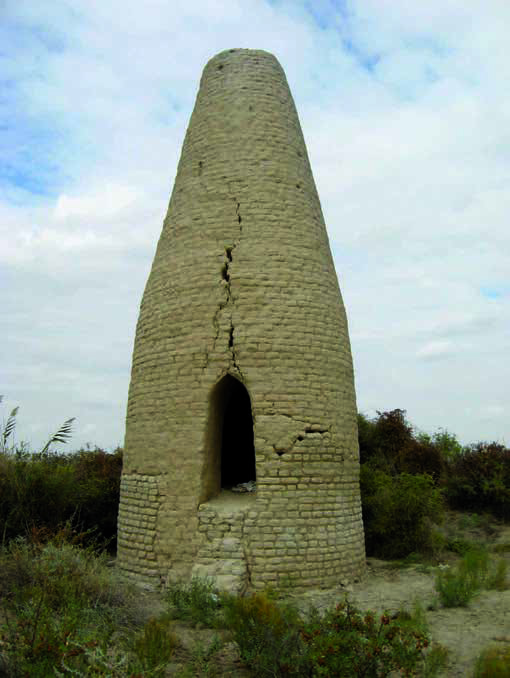
Located 5 km west of the village Akzharma, which is near the city of Kyzylorda. A mausoleum and a tower were erected in honor of Kotibar Batyr. Such towers usually have no burial places, they are erected in honor of a certain person or event. The monument is located on a barrow located on a sandy plain.
Kotibar is a famous batyr of the Shekty family. An active member of the national liberation movement headed by S. Datov. Information on how he participated in the national liberation movement, in solving problems among the people, how he cared about the fate of people, are presented in the literature. There are reports that in 1780-1785 a Batyr with his small unit attacked the fortresses of the Yayitsky Cossacks several times. He joined the national liberation movement headed by Syrym Datov with his 800 warriors, where commanders were Arystan Batyr, Dastan Bi, Karazhigit Bektauuly, Kaidauyl, Otegul. In 1798-1816, when Kotibar was a foreman of the kabak family, he robbed Russian caravans that were on their way to the Khanates of Khiva, Bukhara, and Kokand, and gifted his compatriots with rich prey. Kotibar Batyr participated in the struggle against the troops of Khiva Khanate and Turkmens against their occupation of Kazakh lands. The last years of Batyr's life were spent in the anti-colonial struggle. According to some reports, in 1833, a dispute arose, provoked by the tsarist government, between the clans of Zhagalbayly and Shekty, and Kotibar was found guilty of this on false charges. After that, when Kotibar Batyr drove from the side of Orenburg towards the Besungir mountains, he met with the army of Zhagalbayly Zhankasky Batyr and died in the battle.
Kotibar Batyr occupies a worthy place in Kazakh history. Many legends and tales about the Batyr have survived in people's memory. Thus, in "Ayman-Sholpan" dastan (poem) the personality of Kotibar Batyr is sung as one of the main heroes. People accept him as a sacral person of their era.
The tower is built on a hill, made of mud rectangular brick (10×17×27 cm). Parameters of its volume: diameter of the base - 4.1 m, height - 9.5 m. The body of the tower is round in plan, the lower part is cylindrical, but just below the middle it is sharply narrowed, ending with a truncated upper part. Inside there are four bell-shaped levels, united by anti-aircraft openings in a single space with the possibility of reaching the very top - a very narrow gallery with a low (40 cm) parapet. The narrow entrance opening, decorated with an arch-shaped lancet shape, originally arranged above ground level (about 1.5 m), is located on the southern side towards the Kotibar mausoleum. The tower was built later than the mausoleum, around 1869.
The Kotibar Tower is a monument of deep sacral significance connected with the role of the Batyr in the history of the people. The object is a monument of historical and cultural significance of the republican format. The first data about Kotibar tower are found in the "Archaeological map of Kazakhstan" published in 1960. Here is a brief description and the date of construction (1869).