Information
- Location
- Kyzylorda Region, Shieli District
- Period
- 1501 – 1600
- Category
- Historical and cultural monuments of republican significance
- Type
- Mausoleum
- Kind
- Buildings of monumental art
Sources
- Қазақстанның киелі орындарының географиясы: Табиғат, археология, этнография және діни сәулет өнері нысандарының тізілімі / Жалпы редакциясын басқарған ҚР ҰҒА академигі Байтанаев Б.Ә. – Алматы: Ә.Х. Марғұлан атындағы Археология институты, 2017. – 1-шығарылым. – 904 б.
Description
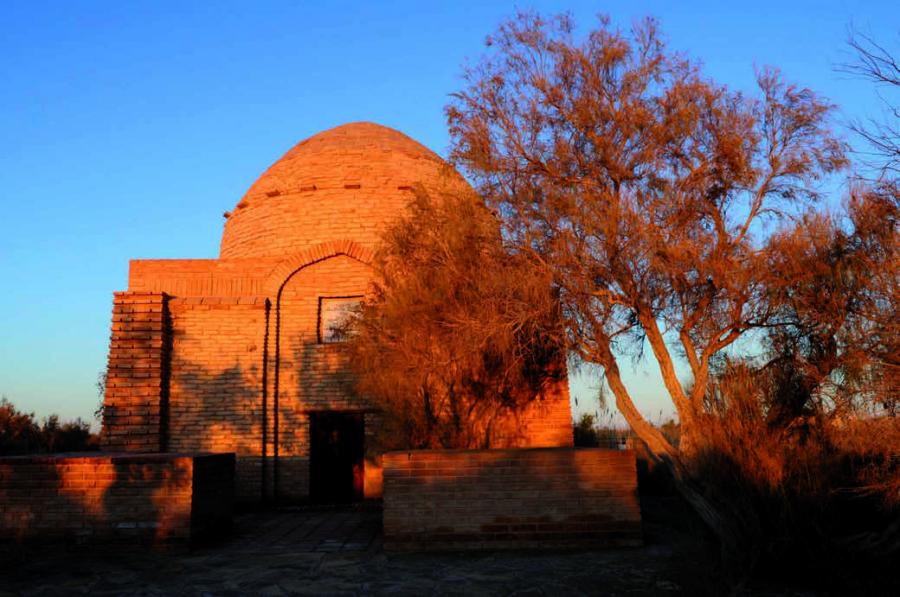
It is situated in 5 km to the east from Baygekum village (Shieli district, Kyzylorda region). Asan ata mausoleum is located next to the mausoleums of Okshy ata, Abyz ata, Kysh ata, Kaip ata, which make up the barrow complex of "Seven saints".
Asan ata is a historical figure revered not only by the Kazakhs, but also by many other Turkic peoples. For the Kazakhs Asan ata is a defender of the people, a wise man, whose blessing was an effective force, a figure who contributed to the solidarity and peacefulness of the people. According to the information that has come to our attention, Asan ata lived approximately in 1361-1470. The people say that he had the gift of prophecy and his predictions came true. Therefore, subsequent generations, honoring Asan ata, made him a hero of stories, legends, epics and several centuries in a row sing his name. Asan ata on his camel Zhelmaya spent his life in search of the promised land - "Zheruiyk", which was a land with green meadows and forests, with clear water, where sparrows knit nests on sheep's wool and the enemy do not attack, and the cattle do not threaten to jute and disease. He believed that there was such a land. He dreamed that all men should be equal and live in harmony and joy. For this purpose, he traveled all over the vast Kazakh steppe and gave his own assessment of each area. When he arrived in Zhideli Baisyn (near present-day Tashkent), he said: "Eh, Zhideli Baisyn, I would have taken you with me, but, alas, you will not fit on my Zhelmaya's croupe". And when I visited Akmeshit, located on the bank of the Syr Darya, I said: "Hey, Akmeshit, your land is small, your waters are steep, and under each bush there is a piece of meat". Seeing the cities of Turkestan and Sauran, he said: "It's a pity you were built on a naked, deserted place, which will not protect you from enemies or the wind. There is no (in this area) water that flows noisily, nor the greenery that sway".
The "Zheruiyk" that Asan ata was looking for was the "Promised Land", the ideal place for a nomadic life with plenty of clean water, rich pastures, mild climate, absence of enemies, troubles and illnesses, with equality of people. The concept of "Zheruiyk" is not limited only to favorable conditions for life, it is a philosophical concept.
To the name of Asan ata, who, caring for the people, for the future of the country, stayed in a brooding sadness, the people added the definition of "kaigy", which means sadness, and began to call him "Asan Kaigy" ("Asan the Sad, or the Bearer").
Asan ata Mausoleum is a cultural and historical monument of republican importance. It was taken under the protection of the state in 1982.
Architecturally, the mausoleum is a square, domed frontal structure. In its construction burnt tile bricks were used. Parameters are 11.5×7.5 m, height 7.6 m. In the upper part of the mausoleum there is a belt made of vertical masonry bricks. It is noticeable that in the facade of Asan ata mausoleum there was an arched frontal entrance. At present, only the remains of the foundation are preserved from them. The architectural structure of the mausoleum is comparable to that of the Syrlytam object, located near the village of Inkardarya in the Syrdarya district.
The mausoleum was erected in honor of an outstanding personality, figure, poet-zhyrau and bi Asan Kaigy. It is necessary to note that to the mausoleum of Asan ata people make pilgrimage, as they perceive Asan Kaigy as a sacred figure. Conditions for religious rituals are provided at the site. The mausoleum has a caretaker and a house for the night. People come here with requests, making sacrifices.