Information
- Location
- Kostanay Region, Amangeldi District
- Period
- 100 BCE – 400
- Type
- Сomplex
- Kind
- Archaeological sites
Sources
- Қазақстанның киелі орындарының географиясы: Табиғат, археология, этнография және діни сәулет өнері нысандарының тізілімі / Жалпы редакциясын басқарған ҚР ҰҒА академигі Байтанаев Б.Ә. – Алматы: Ә.Х. Марғұлан атындағы Археология институты, 2017. – 1-шығарылым. – 904 б.
Description
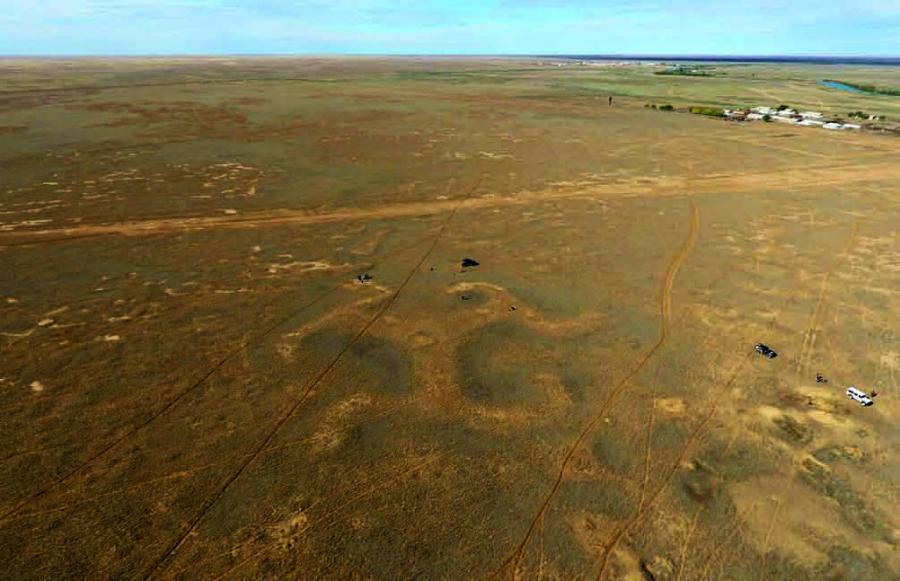
It is located 15 km southeast of the village of Amangeldy, 0.7 km southeast of the village of Agashtykol (Amangeldy district, Kostanay region). On the western shore of the currently dried up lake Agashtykol. The complex consists of 18 ritual-memorial and, probably, burial (dumbbell barrows and embankments, geoglyph 1 Torgay swastika) structures.
The Torgay swastika was discovered in 2007 by Dmitry Dey while studying the space images available in Google Earth. Subsequently, as a result of archeological and geophysical research by the staff of the archeological laboratory of the Kostanay State University named after A. Baitursynov, the entire archeological complex Urpek, which included the "geoglyph" Torgay swastika was discovered.
The Torgay swastika represents the earthen embankment constructed in the form of three beams, each of which comes to an end with the zigzag figure which ends are bent counter-clockwise. The height of the embankment is up to 0.3 m, the beam length is about 33 m, width at the base is 13-15 m, width at the end is 10-12 m. Zigzag-shaped figures are 40-50 m long, 5-6 m wide, and 15-20 m long curved parts. In the center of the building there is a trough. The swastika fits into a circle with a diameter of 90 m.
The remaining structures of the complex are mainly rounded and dumbbell-shaped. Rounded objects with the height from 0.1 to 0.3 m and diameter from 5 to 19 m. Dumbbell barrows or barrows resembling dumbbells are two barrows located along the west-east line and connected by a ridge. The length of the objects varies from 25 to 122 m. The height is from 0.1 to 0.15 m, the diameter of the barrows is from 4 to 10 m. One structure is rectangular in shape, measuring 27×21 m; it is oriented along the NW-SE line.
The construction time of the Urpek ritual complex can be preliminarily determined by broad chronological frames from the I century BC - until the IV (V) century AD.
In general, the archaeological complex Urpek, apparently, was a sacred place for the ancient inhabitants of Torgay, as it includes a significant number of ritualistic and probably funeral (dumbbell barrows and embankments) monuments. The construction in the form of a swastika (Torgay swastika) is also a kind of symbolic sign, perhaps, determines the belonging to a clan or community.
It is a monument of archeology of local importance. Object of pilgrimage and tourism.