Information
- Location
- Kostanay Region
- Period
- 3300 BCE – 1200 BCE
- Type
- Сomplex
- Kind
- Archaeological sites
- Authors
- Усманова Эмма Радиковна
Sources
- Қазақстанның киелі орындарының географиясы: Табиғат, археология, этнография және діни сәулет өнері нысандарының тізілімі / Жалпы редакциясын басқарған ҚР ҰҒА академигі Байтанаев Б.Ә. – Алматы: Ә.Х. Марғұлан атындағы Археология институты, 2017. – 1-шығарылым. – 904 б.
Description
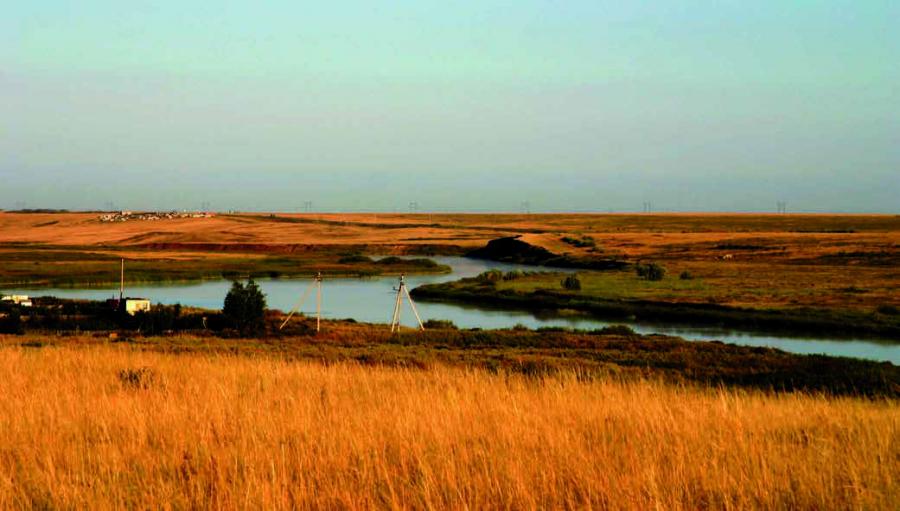
The complex of monuments includes one settlement and seven burial grounds located on the right and left banks of the Tobol river near the town of Lisakovsk (Taranov district, Kostanay region).
In 1983, at the rocky exit of the right bank of the Tobol River, a schoolboy from Lisakovsk, S. Yatsuk, accidentally discovered a settlement of the Bronze Age. The monument was inspected by A.P. Maznichenko, an employee of the Kustanay regional inspectorate on monuments protection. The settlement was in the zone of destruction of the river shoreline. Rescue archeological works have been begun in 1985 by the Lisakovsk group of archeological expedition of the Karagandy state university of a name of E.A.Buketov under the direction of V.V. Varfolomeyev. Since 1986 and till nowadays the research of monuments of Lisakov district is headed by the scientific employee of the Saryarka archaeological institute at KarSU E.R.Usmanova. The curator of researches is archeologist A.S. Suslov (Lisakovsk). At different times, the excavations of the monuments of the Lisakov district were attended by Karagandy archaeologists - V.G. Loman, I.A. Kukushkin, A.Yu. Chindin, M.V. Bedelbayeva, A.P. Maznichenko, V.A. Novozhenov, Kostanay archaeologists - A.V. Kolbina, B.M. Khasenova, researchers from Astana - V.V. Volovinsky, I. Volovinskaya. Archaeologists and specialists from Russia also contributed to the study - Ye. Perevodchikova, I. Ksenofontova, A. Akulov, V. Fedorov, M. Skripnikova, N. Pavlova, U. Trayner, O. Nikulina, G. Evdokimov; from the USA - Alicia Ventresca Miller, Irina Panyushkina.
The first barrow of the Lisakovsky I burial ground was excavated in 1986. In the following years, other six burial grounds were studied. The presence of a large number of multi-temporal funeral monuments from the Bronze Age to the late Middle Ages and ethnographic modernity, concentrated along the coastline of the Tobol River and around the city within a radius of 10-12 km, indicates the active settlement in ancient times in this area. One day, 3,000 years ago, this place was chosen by Andronovs to perform their rituals. The choice was not accidental: the full-flowing Tobol River, convenient pastures in the low floodplain, rich clay deposits. The high plateau and the red stone of the coastal cliffs attracted many generations of people to the area for a long time. Tuff red stone was used for the construction of burial and cult structures. The ancient sacral essence of the area is fixed in the Turkic name "Kyzylzhar" (Red Cliff).
Four dwellings and 233 burials of the Bronze Age were excavated. At the burial ground Lisakovsky I coexisted two funeral traditions: Fedorov and Alakol. Radiocarbon chronology of Lisakovsky monuments confirmed the coexistence of Alakol and Fedorov population in the period of 1780-1660 BC. Funeral fields were used for at least 120 years. Several funerary structures of the early Iron Age and early Middle Ages were investigated: a barrow with a mustache and a barrow with a burial place of a "Kypchak warrior".
The burials of the Bronze Age are performed in the stereotypes of Andronov's rituals - burial structure ( barrow-fence), dead (buried by the method of corpse or burning), burial equipment, sacrificial complexes. There is a special category of symbolic burial - a cenotaph, without bone remains of the dead or with the content of his symbolic deputy. A special symbolism in the form of the cult of the skull is manifested in the Alakol burials - it is cephalotaphy - separately buried skulls or parts of it.
The found material is the archeological collection of the Lisakovsk Museum of History and Culture of the Upper Tobol Region. These are ceramic vessels, gold jewelry in the form of rings, bronze ornaments: rings, bracelets, pendants, hair ornaments. Due to the property of local soils, wooden constructions in the burial chambers, fragments of textiles and wicker clothes decorations, as well as a very rare find - a wooden idol - were found, apparently, it was used in rituals dedicated to the cult of fertility. In terms of sacral development of space, the inhabitants of the steppe of the II millennium BC were the first to understand the law of placing the ritual object of the barrow-fence in the form of "imitation" of the dome of the sky. All the nations that followed them - Saks and Turks - only repeated it, thus confirming one of the main features of the steppe mentality, independent of religious affiliation: a special way of seeing the space and marking it in the form of a barrow.
It is a monument of archeology of local importance. The object of pilgrimage and tourism.