Information
- Location
- Kostanay Region, Arkalyk city
- Period
- 0 – 1900
- Type
- Сomplex
- Kind
- Archaeological sites
Sources
- Қазақстанның киелі орындарының географиясы: Табиғат, археология, этнография және діни сәулет өнері нысандарының тізілімі / Жалпы редакциясын басқарған ҚР ҰҒА академигі Байтанаев Б.Ә. – Алматы: Ә.Х. Марғұлан атындағы Археология институты, 2017. – 1-шығарылым. – 904 б.
Description
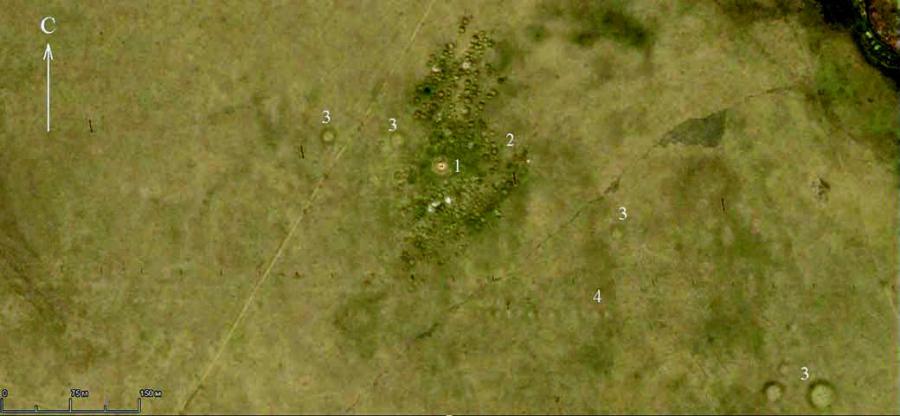
The monument is located 5 km west of the village of Kaiyndy in the territory subordinated to the maslikhat of Arkalyk (Kostanay region). The complex consists of a destroyed brick structure (mausoleum?), around which there are stone, stone-earthen and earthen barrows (more than 200) and geoglyph Kaiyndy Line.
The mausoleum is severely damaged, so it is difficult to imagine its original appearance. It is built of mud and baked bricks and looks like a kind of tower mausoleum, the continuation of which is a horizontally extended computation of mud bricks. The size of the base is 6×2.5-4 m, the height of the preserved part is up to 3.6 m, and the size of the brick is 30×30×7 cm. In the diary records of Captain N.Rychkov, which he kept during his trip to Torgay in 1771, apparently, we find a description of this very structure: "On the eastern side of the river Karaga or Torgay there are the remains of an ancient building made of brick and slab stone like a prayer temple... On the eastern side of it there is a spacious opening, which serves instead of the gates of this temple, into which you will find a very skillfully laid out tile stone ... and two small windows illuminate the inside of it. There are a lot of tombstones in its surroundings" [Cit. by: Rychkov, 1772, p. 63].
Around the mausoleum there are barrows of small size, with a diameter of 3 to 10 m and a height of up to 0.5 m. Some barrows have steles with carved tamga images. Next to the main cemetery there are several more barrows. Judging by their parameters (their diameters are from 10 to 50 m, the height of 0.2-0.4 m), these are older barrows dating back to the Bronze Age - the early Iron Age. 0.8 km south of the cemetery is the geoglyph of the Kaiyndy Line, which consists of 13 earthen embankments built in a row. The length of the line is 145 m, oriented on the axis W-E. The embankments are 6 m in diameter and 0.05 m high.
Among the currently known memorial objects, the mausoleum of Kaiyndy has no analogues, but some architectural details, equipment and material are comparable with some structures within Kazakhstan. Tower cone-shaped structures made of mud brick have been spread in the Kazakh steppes since Oguz time and continued to be built until the end of the XIX - beginning of the XX century. The form of the tower under consideration is similar to the gravestones from the Aral Sea region and the lower reaches of the Syr Darya in the second half of the XIX century.
Images of at least three types of tamga signs in the form of tamgas are fixed on the tombstones: «V», «ϙ», «O». The sign "V" is similar to the tamgas of Kazakh clans of Shekty and Tortkara from the Junior Zhuz. Based on the data of pre-revolutionary researchers, V.V. Vostrov and M.S. Mukanov note that the sign "V" was a common tamga for the tribe of Nayman of the Middle Juz, and was also used by the Nayman clans of Baganaly and Karakerey. On the basis of the recent analysis of literary data and archival materials, A.K. Talasbayeva and A.E. Rogozhinsky came to the conclusion that such a sign did not belong to any kind of nayman family and was not a tribal tamga.
The sign «ϙ» is similar to the tamgas of the Argyn tribe from the Middle Zhuz, the Nayman clans of Sadyr and Teristamgaly, the subgenus of Shomishti-Tabyn and the clan of Ramadan of the Junior Zhuz. It should be noted that a similar tamga belonged to some clans of the Alban and Suan Elder Zhuz tribes.
The sign "O" is identical to the tamgas of the tribes of Adai, Argyn, the clan of Sadyr from the tribe of Nayman and the tribe of Dulat of the Elder Zhuz.
The tamgas under consideration could belong to different clans and tribes of the Kazakhs. Based on the above analogies and data on the settlement of Kazakhs in the Torgay, Kostanay, Yrgyz and Atbasar counties at the end of the XIX - beginning of the XX centuries, it is possible to attribute the data of tamgas and part of the complex of Kaiyndy to the tribes of Argyn, Nayman, clans of Shekty and Tortkara. As a whole, the materials described here, apparently, belong to the Kazakh clan cemetery of the XVIII - early XX century.
The Kaiyndy is a unique archeological and historical complex, which was developed by different ethnic groups from the period of deep antiquity to the beginning of the XX century. The specified chronological frameworks underline the sacredness of the area near the banks of the steppe quiet river Karaturgay (Karatorgay) for millennia.
It is a monument of archeology and history of local importance.
The object of pilgrimage and religious tourism.