Information
- Location
- Karaganda Region, Karkaraly District
- Period
- 1862 – 1900
- Type
- Mausoleum
- Kind
- Buildings of monumental art
Sources
- Қазақстанның киелі орындарының географиясы: Табиғат, археология, этнография және діни сәулет өнері нысандарының тізілімі / Жалпы редакциясын басқарған ҚР ҰҒА академигі Байтанаев Б.Ә. – Алматы: Ә.Х. Марғұлан атындағы Археология институты, 2017. – 1-шығарылым. – 904 б.
Description
It is located 12 km north-east of the village of Arkalyk (Karkaraly district, Karagandy region).
Tattimbet Kazangapuly (1815-1862) was a talented kuishi, dombrist, composer, one of the founders of the school of dombra playing in the style of shertpe, a classic of Kui folk art. Tattimbet at a young age showed interest in public affairs. The West Siberian governor-general, Major General Von Friedrichs, in his records points to the origin of Tattimbet from the "blue blood" dynasty. In fact, he was a nobleman of the family. Tattimbet Kazangapuly since January, 20th, 1842 till January, 25th, 1845 was the volost governor in Karkaraly district, Nurbike-Shansharskaya volost. Has refused a post at own will.
Thanks to his natural talent, Tattimbet managed to improve his musical skills, which were obtained from the Kazakh performers of the instrumental play - kui and became one of the best. The high appreciation of the musical art of Tattimbet was one of the reasons why he was included in the Kazakh delegation from Saryarka for the inauguration of Emperor Alexander II in St. Petersburg in March 1855. In the capital of Russia he was awarded a silver medal on the Annensky ribbon. This medal was kept by a resident of Yegindy-Bulak district of Kenshar economy great-grandson of Tattimbet Uzek Kabishuly.
His younger brother Zhaksymbet and his sons promoted Tattimbet's work. Retaining the originality and peculiarities of Tattimbet's musical works, they created a school of Kuishi. Most of Tattimbet's kuis have been used by composers in modern symphonic, operatic and chamber instrumental works: kuis "Bylkyldak", "Kosbasar" in Yevgeny Brusilovsky's opera "Kyz Zhibek" and "Abai" by Zhubanov and Hamidi, kuis "Sary Zhailau" in the film "Zhambyl", kuis "Sylkyldak" became the basis of Sagatov's play for trumpet and orchestra. His works became available for foreign music lovers thanks to the publication of CD-album Dombradu Kazakhstan: L`heritagede Tattimbet ("Kazakh dombra - the heritage of Tattimbet") (BudaMusique), which was released to the 150th anniversary of the death of the Kuishi in 2010 in France in the series "World Music".
In 1984, a monument in honor of Tattimbet Kazangapuly was erected in Yegindi-Bulak district of Karagandy region. The Almaty State Conservatory (the current Kazakh State Conservatory) has had a shertpe-style class since 1971. It is based on the Tattimbet kuis, as well as the traditions of other shertpe kuis.
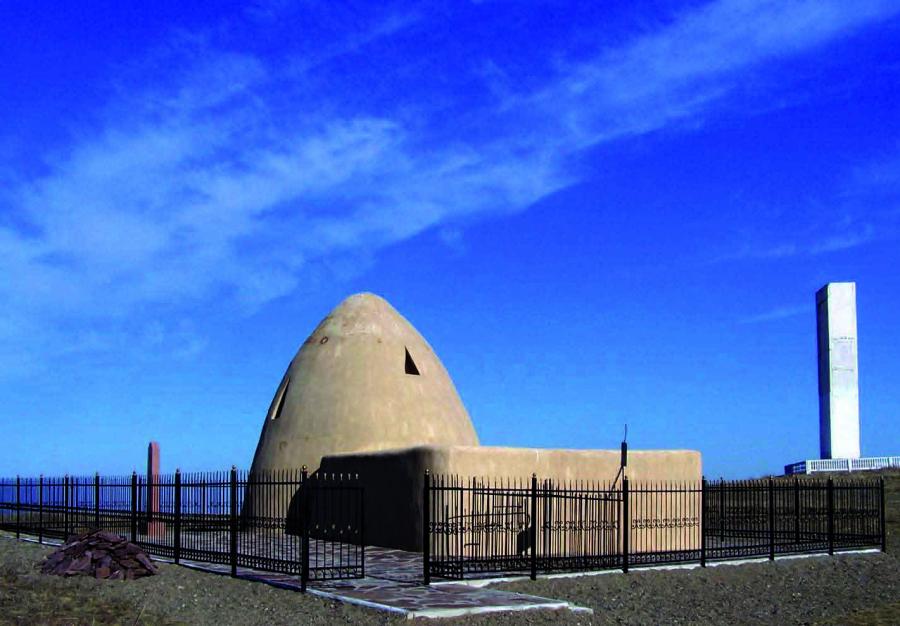
The composer's grave is fenced with an iron fence. Inside there are three canvases. In the first one, Tattimbet's father Kazangap is buried, and in the second one, Kazangap's first wife and Tattimbet's mother, Kalaiy, are buried. In the third, Tattimbet himself is buried. Above the grave there is a dome-centric mausoleum made of mud brick. The transition from the quadruple to the octagon is made by means of corner arches. A gravestone with the inscription "To the Dear Tattimbet from A. Bektosov and K. Ashimbekov" is installed. September 20, 1963.
The mausoleum is an architectural monument of local importance. The object of pilgrimage and worship before the memory of the Kuishi.