Information
- Location
- Karaganda Region, Zhanaarka District
- Period
- 1500 BCE – 1001 BCE
- Category
- Historical and cultural monuments of republican significance
- Type
- Necropolis
- Kind
- Archaeological sites
- Authors
- Ахияров Ислам Кизамединович
Sources
- Қазақстанның киелі орындарының географиясы: Табиғат, археология, этнография және діни сәулет өнері нысандарының тізілімі / Жалпы редакциясын басқарған ҚР ҰҒА академигі Байтанаев Б.Ә. – Алматы: Ә.Х. Марғұлан атындағы Археология институты, 2017. – 1-шығарылым. – 904 б.
Description
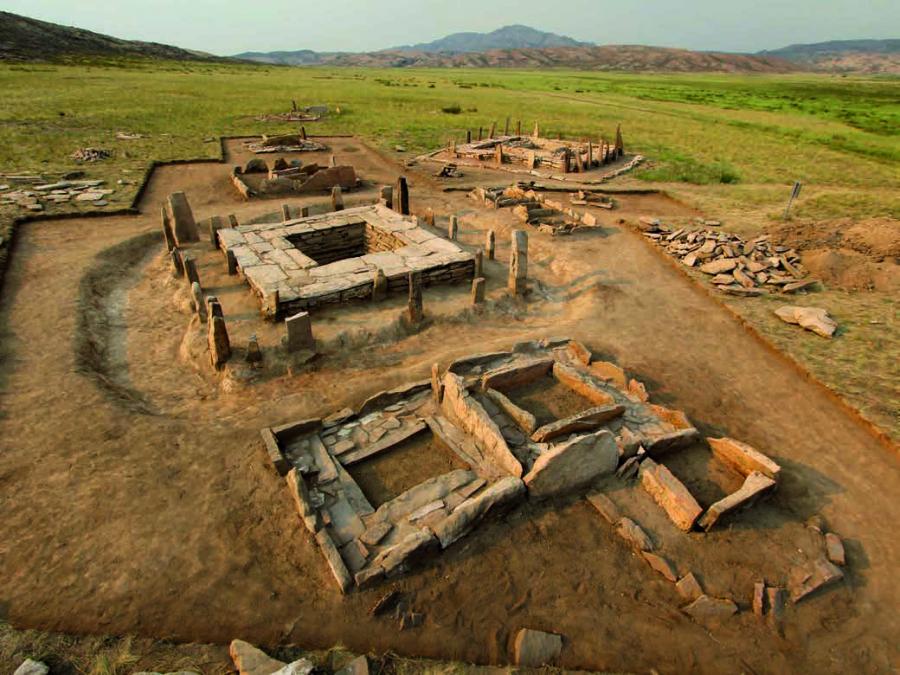
Monument of archeology, middle of II millennium BC. It is located 1.2 km southeast of Darat wintering, on the right bank of the Atasu River, at the entrance to the Sangiru Gorge (Zhanaarka District, Karagandy Region). The monument was unveiled in 1955 by the Central Kazakhstan Archaeological Expedition (CSAE). Excavations were carried out at mausoleums No. 1, 7, 8 and a number of other objects in 1955 and 1963. In total, 15 fences of the Bronze Age, as mentioned by A.Kh. Margulan, have been studied, all objects were looted in ancient times. The materials obtained in the course of the study are reflected in articles and two monographs in 1966 and 1979. The burial site is one of the monuments of the Atasu archaeological district (according to M.K. Kadyrbaev).
Research at the Sangyru tract was resumed in 2014 under the direction of A.Z. Beisenov. A series of works was carried out in connection with the additional research, as well as conservation and restoration activities. The central objects of the Sangyru-1 burial ground are rocky mausoleums No. 1, 7, 8, belonging to the Begazy-Dandybay culture. Mausoleum No. 1 is located separately in the western part of the burial ground. The size of the outer walls of the mausoleum is 9×10 m, the width of the walls is 2 m, the height is 1 m. The dimensions of the inner walls were 4.36×4.4 m, the height - 1.2 m. They were dug into the ground and framed by large slabs embedded in the rib. The burial chamber is a box of sub-square shape, with sides of more than 3 m and a height of 1.2 m. A bronze axe was found in the northern part of the mausoleum during cleaning.
Mausoleum No. 7 also belongs to the monuments where the representatives of the ruling elite of the ancient society are buried. This is evidenced by the fact that it is somewhat separate from other sites and that it is the largest in the burial ground of Sangyru-1. This object architecturally resembles the tiled tombs of Begazy. The mausoleum is formed by three walls, between which a bypass corridor is fixed. The dimensions of the first (outer) wall are 10×10 m, the second is 8.4×8.4 m, and the third (inner) wall is 5.5 m. In the center is a stone crypt in the form of a large square box made up of four large slabs, dug into the rib. The size of the box is 2.4×2.4 m and its height is 1 m. Mausoleum No. 8 is a square structure with a cyst chamber in the center. The dimensions of the outer sides are 8×8 m. The perimeter of the mausoleum is surrounded by a 1 m wide moat. Menhirs are installed along the moat. A bronze Celt was discovered in the course of the new clearing of the structure.
During the new investigations, 15 fences and the three above-mentioned mausoleums were completely recultivated in the disposal facility. The presence of fences and mausoleums of different sizes and configurations in one burial ground indicates the established hierarchy in society. Apparently, ordinary citizens of the community were buried in the small fences, while nobility was buried in the mausoleums. The burial ground is one of the brightest and most important monuments of the Begazy-Dandybay culture of Central Kazakhstan. For the first time the radiocarbon data (Great Britain) allowed to include the burial ground Sangyru-1 to the group of early monuments of Begazy-Dandybay culture, having defined its date in the middle of the II millennium BC. From later constructions on the territory of the burial ground there is a barrow with "moustaches" of the early Iron Age, excavated in the same years. It is noteworthy that people chose the location of an older burial ground, which was the tomb of the ruling classes of society, to perform the ritual and to build the moustache barrow. The picturesque valley of Sangyru is visited by tourists, as well as lovers of antiquity and nature from the surrounding area. The taken measures on recultivation and restoration of the objects studied earlier, including large stone tombs of Begazy-Dandybay culture, positively influence the development of tourism, in propaganda and dissemination of knowledge about the historical and cultural heritage of Central Kazakhstan.