Information
- Location
- Karaganda Region, Ulytau District
- Period
- 1201 – 1300
- Category
- Historical and cultural monuments of republican significance
- Type
- Mausoleum
- Kind
- Buildings of monumental art
- Authors
- Ахатов Ғазиз Аманжолұлы
Sources
- Қазақстанның киелі орындарының географиясы: Табиғат, археология, этнография және діни сәулет өнері нысандарының тізілімі / Жалпы редакциясын басқарған ҚР ҰҒА академигі Байтанаев Б.Ә. – Алматы: Ә.Х. Марғұлан атындағы Археология институты, 2017. – 1-шығарылым. – 904 б.
Description
It is located 45 km north-east of Zhezkazgan (Karagandy region). The complex, along with the mausoleum of Zhoshy khan, includes an unstrengthened settlement and a number of medieval mausoleums. Kazakh mazars are also located here.
The first information about the mausoleum of Zhoshy khan in written sources dates back to the XVI century and can be found at Hafiz Tanysh ben Mir Muhammad al-Bukhari. In his work "Sharaf-name-yi Shahi", he, describing the campaign of Bukhara ruler Abdallah to Ulytau in 1582, mentions the mausoleum of Zhoshy khan: "On Saturday of the 6th (day of this) month (khan) stopped near (navahi) Sarai in front of the mazar of Juchi-khan".
Information about Zhoshy Khan's mausoleum is available from reconnaissance expeditions, travelers, topographers, military, etc. In 1946 the mausoleum of Zhoshy Khan was examined by the Central-Kazakhstan archeological expedition headed by A. Kh. Margulan. The burials in the mausoleum of A. Kh. Margulan refer to Zhoshy Khan and his wife. According to historical legends, Zhoshy, the eldest son of Genghis Khan, is buried in the mausoleum. Different variants of legends about the mysterious death of Zhoshy, still preserved by the Kazakhs, are recorded in the sources.
The legends are based on the motif "Aksak kulan Zhoshy khan" in different variants. The author of "Genghis-Name" ( XVI century) reports the following: "Zhoshy khan was the eldest of his (Genghis Khan's) sons. He gave him a large army and sent him to the vilayette of Desht-i Kypchak, he said: "Let it be a pasture for your horses." He also gave (to him) the vilayette of Khorezm. When Zhoshy khan went to the vilayette of Desht-i Kypchak, he reached Ulug-Tag (Ulytau. - Aut.), which is known. One day, when he was hunting in the mountains, he met a herd of marals and saigas. Pursuing him and firing arrows, he fell off the horse, broke his neck and died.
One of the legends is given in the work "Shajarak al-atrak", where the news to Genghis Khan about the death of Zhoshy Khan was reported by Ulug Jirchi (in Kazakh Zhyrshy). Genghis Khan answered as if he had uttered Turkic jir (in Kazakh zhyr):
Kulu algan kulandai kulunumnan airyldym
Ayrylyshkan ankudai er ulumdan ayryldym.
There is a variant of the legend, where Zhoshy Khan is the son of Alasha Khan, to whom the news of his son's death is reported by zhyrshy Ketbuga playing a musical instrument. The Kazakhs are still playing the kui "Aksak kulan", which allegedly informed about the death of Zhoshy Khan.
Next to the mausoleum of Zhoshy Khan there is a medieval settlement of Zhoshy-Ordasy, which is identified with the city of Orda-Bazar from written sources. It is established that the mausoleum of Zhoshy Khan and the settlement form a single complex of the period of Zhoshy ulus, where the mausoleums played the role of religious buildings.
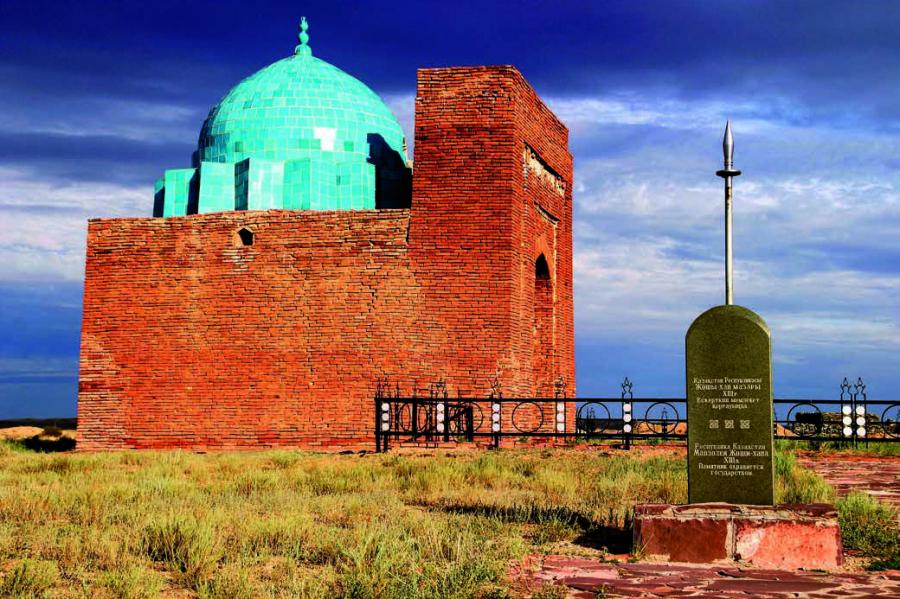
The mausoleum of Zhoshy Khan is located on the low but dominant hilly bank of the river Kara-Kengir and is clearly visible from afar. It belongs to the portal-dome type of memorial constructions. The main facade consists of a peshtak - a portal with a lancet arch over the deep niche of the entrance opening, oriented to the south-west.
For the construction of this mausoleum, a red burnt brick of excellent quality was used. The size of the mausoleum in the plan is 7.25×9.25 m. The preserved height of the portal is 7.85 m, the domes - 7.1 m. The walls of the mausoleum have no architectural and decorative ornamentation. The walls inside the mausoleum are plastered with clay and samanese mortar. The mausoleum has two domes: internal - hemispherical and external - spherical-conical, installed on two drums: the lower 17-star drum and the upper one round.
At the top of the dome, resting on a round drum, there is a kubba (cap) with green watering. The "horns" of the kubba are oriented along the east-west axis. Facing of a faceted drum and an external dome was conducted by square plates with blue glaze on a clay solution. The round drum is faced with blue plates with rosette ornament. The ground in front of the main facade, as well as the floor of the mausoleum, laid out square burnt bricks.
The Mausoleum of Zhoshy khan is one of the remarkable cult constructions of the medieval epoch, it is the object of pilgrimage and tourism. It is an architectural monument of republican importance and is under state protection.