Information
- Location
- Karaganda Region, Ulytau District
- Period
- 1727
- Type
- Historical landscape
- Authors
- Байтілеу Дархан Айтжанұлы
Sources
- Қазақстанның киелі орындарының географиясы: Табиғат, археология, этнография және діни сәулет өнері нысандарының тізілімі / Жалпы редакциясын басқарған ҚР ҰҒА академигі Байтанаев Б.Ә. – Алматы: Ә.Х. Марғұлан атындағы Археология институты, 2017. – 1-шығарылым. – 904 б.
Description
It is located 20 km south-west of Baikonyr village (Ulytau district, Karagandy region).
The place of the Battle of Bulanty is directly connected with more than a century of struggle of the Kazakh people against Dzungarian aggression. The so-called place of the Battle of Bulaty is the area where the decisive battle of the Kazakh militia with dzungars in the first half of the XVIII century took place. The forerunner of the battle was a significant event in the history of the Kazakh statehood - the unification of Kazakh zhuzes in a single force to reflect the aggression of foreign invaders.
Unfortunately, written evidences of battle are not found out, but, taking into account oral traditions of transfer of the information and materials of folklore, and also the data of archeology and toponyms, scientists have defined a place where there was a battle, without exaggeration - the major event in a history of the Kazakh people.
One of the first comprehensive studies of the battle areas in the Ulytau region, including the Battle of Bulanty, was conducted in 1998. The first expedition of the same name "Battle of Bulanty" was held in 1998 with the participation of the State Archive of Zhezkazgan, the Akimat of Zhezkazgan, Zhezkazgan University named after O.A. Baikonurov, Karagandy State University named after Academician E.A. Buketov, Industrial museum of the "Corporation Kazakhmys" and local ethnographers. In 2007, in the course of a large-scale field survey, taking into account the geomorphological characteristics of the area, the Kazakh Research Institute for Cultural Heritage Problems identified one of the proposed places where the so-called Battle of Bulanty - the Karasere tract (Karasuyr people's toponym) - took place. Studies of the battlegrounds of the Kazakh militia with dzungars in the Ulytau region were carried out episodically until 2015.
As a whole the end of XVII - beginning of XVIII centuries is the difficult historical period of struggle of the Kazakh khanate against dzungar expansion. Dzungars invaded the territory of Zhetysu, as well as the valleys of the rivers Shu and Talas. During this period, dzungars managed to capture about ten thousand prisoners. In response to individual clashes with dzungars in 1702-1703, Kazakh militia organized a simultaneous attack on Dzungaria and the Volga Kalmyks.
Despite the diplomatic efforts of Tauke Khan to establish peaceful relations with Dzungarian Juntaiji, in 1708 the Kazakhs again had to repel individual attacks by Dzungaria. The war took on a protracted character and was a mixed success in subsequent years.
In 1723-1725, with the aim of expanding the territories and restoring the economy, which had been destroyed by the war, the dzungars made a number of decisive incursions into the territory of the Kazakh khanate. In 1723, Kazakhs of Zhetysu and Irtysh region were the first to receive the attack. In the oral Kazakh legends this period is called "Aktaban Shubyryndy". ("Years of great disaster"). The symbol of the Kazakh people's grief about this tragedy was the zhoktau (crying song) "Yelim-ai" ("My Homeland").
In the 20 years of the XVIII century dzungars, taking advantage of feuds among the Kazakh tribes, occupied a huge part of the Kazakh lands. The western border between the Kazakh nomads and dzungars of that time can be called the Ulytau Mountains, as well as Lake Balkhash. Dzungars cut off the Kazakh khanate from such urban craft centers and markets as Tashkent, Turkestan and Sairam.
The nationwide disaster, which brought the Dzungarian invasion, caused not only despair in the Kazakh people, but also comprehension of what is happening. Loss of many pastures, relocation of various clans and communities to new lands forced various strata of Kazakh society to take into account the difficult reality. There was a need to unite different regions to organize the repulse of the enemy. In these conditions it was necessary to have public consent. And in it the big role was played by the known in the people Kazakh batyrs, outstanding bis and people. The Kazakh militia was headed by Batyrs - Kabanbay, Bogenbay, Malaisary, Nauryzbai, Shakshak Zhanibek and others. By 1726-1727, sultans and bis began to pursue a broad policy of uniting all Kazakh clans against the conquerors.
In the autumn of 1726, the All-Kazakh Congress was held in the area of Ordabasy. At the congress were invited khans Abulkhaiyr, Abilmambet, Sameke, Kushik, Zholbarys, sultans, bis of different clans, famous commanders and batyrs. The main issue at the congress was the question of organizing a national repulse for dzungars. In the conditions of the looming threat, the internal clan contradictions and the struggle for power over all the Zhuzes were overshadowed. In Ordabasy Abilkhaiyr was elected the leader of the Kazakh militia.
One of the major battles took place in 1727 on the bank of the Bulanty River, in the area of Karasuyr. At the head of the entire confederation of tribes was Abilkhaiyr. The Kazakh army of 30,000 men caused an impressive defeat to the Dzungarian forces. The place of battle has received the name "Kalmak kyrylgan" ("Place of death of Kalmyks"). Thus, the Battle of Bulanty was one of the first in a series of historical events that contributed to the unification of Kazakhs and the preservation of territorial integrity. It was in the foothills of the Ulytau Mountains that a powerful militia of all three zhuzes was gathered for the first time; here, for the first time, a call was made not to share, which served to increase the self-awareness of Kazakhs as a single, whole nation. A triumphant procession of Kazakhs began in the foothills of Ulytau.
The victory raised the spirit of the people, made them believe in their own strength, in the ability to defeat the conquerors. The Kazakh militia intercepted the initiative and launched a counteroffensive.
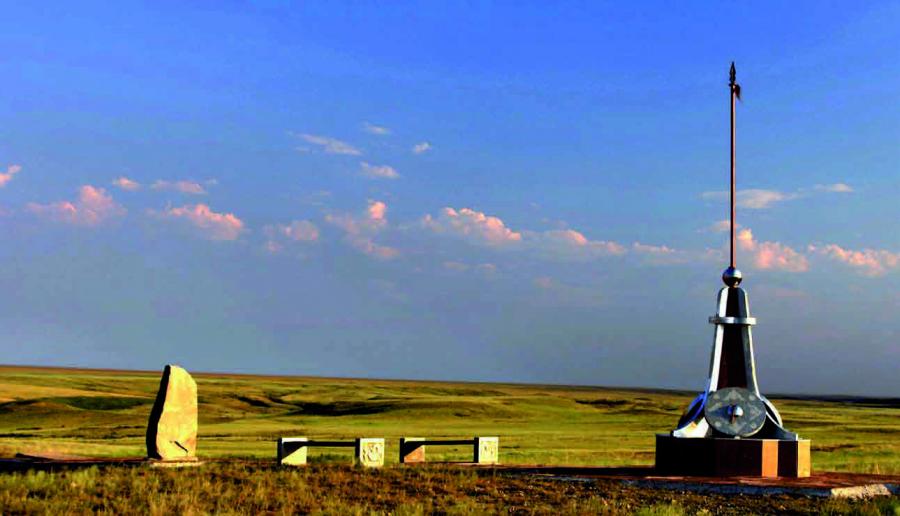
In 2015, in honor of the 550th anniversary of the Kazakh khanate in the tract Uitas, near the river Bulanty was erected a monument "Battle of Bulanty". The place of the Battle of Bulanty is included in the territory of the National Historical, Cultural and Natural Reserve-Museum "Ulytau". It is the evidence of the high degree of self-organization of the Kazakh society; the symbol of selflessness, will to victory and independence; the embodiment of the role played by the Kazakh people in the struggle of the Turkic peoples of Central Asia against the Dzungarian invasion.
It is the object of tourism.