Information
- Location
- Karaganda Region, Zhanaarka District
- Period
- 0
- Type
- Menhir
- Kind
- Archaeological sites
- Authors
- Касенова Асемгуль Дауреновна
Sources
- Қазақстанның киелі орындарының географиясы: Табиғат, археология, этнография және діни сәулет өнері нысандарының тізілімі / Жалпы редакциясын басқарған ҚР ҰҒА академигі Байтанаев Б.Ә. – Алматы: Ә.Х. Марғұлан атындағы Археология институты, 2017. – 1-шығарылым. – 904 б.
Description
The complex is located in the Aksai valley on the river Atasu (Zhanaarka district, Karagandy region).
In Central Kazakhstan, in river valleys or on flat intermountain areas, stone pillars (menhirs, steles) are often found alone or in a group of more than 20 vertically excavated ones. The surface of the stones is carefully processed, and sometimes there are untreated stones. Installation of steles is especially developed in the Bronze Age. They have a ritual significance, as they are associated with the cult of ancestors.
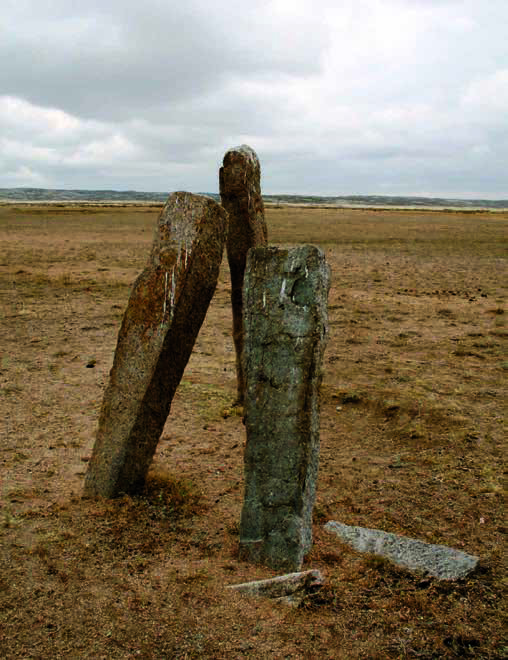
One of the ancient ritual monuments is a well-preserved complex in the valley of the Aksai River, a right tributary of the Atasu River. A group of more than 10 steles was installed in the eastern part of the valley on a flat ground, visible from a distance of 1-2 km. Depending on the types of steles, it can be assumed that this sacred place has been functioning for a long time, for at least 500-600 years, from the Middle Bronze Age to the early Iron Age. The early monuments include the roughly shaped rectangular stone pillars in the section, then there appear carefully processed with a sculptural head of a ram and a horse, with a pointed upper part, sometimes with the image of horns or with a solar circle in the upper part. A special place in the group is the place where three steles were dug into the group, forming a triangle at the base. Their tops are inclined inwards. All three steles are different.
One of them is a pan-Eurasian type of reindeer stone with rings on two opposite sides and a belt marked with a groove. The narrower profile of the "head" section is decorated with a ledge on one (front or back) side; the top is flat. The second stele has the upper part of the stele broken off, and there are no images on the preserved fragment; near the base two flat stones appear from the ground. At the top of the third stele, a face turned towards the other two steles of the triad is reproduced by a shallow knockout [Ermolenko, Kurmankulov, 2014, p. 334]. The grouping of these three objects may be evidence of their simultaneity and the coexistence of anthropomorphic reindeer stone with clearly anthropomorphic steles. Deer stones with larvae are known among the monuments of the eastern region of Eurasia.
To the north, 200 m from them, there is a second group of monuments, where the steles of different times are concentrated. The earliest of them is the carefully processed "sheep" stone ("koitas" in Kazakh) with a pointed face turned to the sky. There is a small barrow with a moustache (stone ridges stretching to the east) with a high stele (height over 4 m), in the upper part of which there is an image of a human face, printed with a punch.
This group is interesting in that one complex combines three types of ritual objects, reflecting different beliefs: worship of animals, worship of a man - a hunter and a warrior, the cult of ancestors, the Sun.
The sacredness of the Aksai Valley has been preserved even later. In 4 km to the north-east on the same coast in the complex of mounds, including those with "mustache" of the early Iron Age, there is a high stone stele (more than 4 m) with the image of a larvae in the upper part, because of which the locals call it Akbikesh - "Atasu beauty". The image is made of bas-relief, facing east, on the side edges there are images of earrings (?). Next to the monuments there is a wintering of cattle breeders. The shepherds note that the area is very convenient for farming and the loss of livestock is smaller than in other areas.
It can be assumed that the complexes, including moustache barrows and steles, are associated with the practice of memorial rituals. The solar cult, horse sacrifice and other religious and philosophical aspects of ancient nomads are intertwined here. Installation of stele and sculptures, including those in the system of moustache barrows, makes it possible to trace the development of tradition from elite mausoleums of Begazy-Dandybay culture of the late Bronze Age to stone sculptures of ancient Turks.
Reindeer stones, steles and sculptures are connected with cult places, they are an integral part of sacrificial complexes and ancient sanctuaries. Their purpose is connected with the idea of sacrifices.
Stone steles, reindeer stones and sculptures are markers of nomadic culture of the I millennium BC. Their installation in the funeral and storage complexes since the late Bronze Age reflects changes in ideology and religious beliefs in the society of equestrian warriors. New value orientations were reflected in the ritual sphere.