Exploration of the upper layers (16th-17th centuries) continued in the urban area of the southeastern part of the settlement. The excavation was adjacent to the southern gates of the city and the main street at a distance of 50 m. The total area of the excavation was 1.5 hectares.
One of the significant achievements is identifying the street network, which, thanks to the good preservation of the selected site, was noted even before the excavations. In work, two streets were found running parallel to the central one, from which intra-quarter alleys and dead ends go inward, to the edge of the settlement. The presence of a clear street network confirms the normal development of the city. Eight quarters have been identified, of which four have been excavated in their entirety. Their layout and dimensions do not differ from those previously known.
In quarters up to 2000-2500 sq. m, there are from eight to 12 households. Houses of two types - long, from several (up to four) enfilade rooms, and sub-square, where the rooms are arranged crosswise. The central room of the house has a universal tandoor hearth with a chimney led into the wall by a vertical wall. The house has a summer room covered with a canopy, and the other is a patio paved with bricks. There were also barns with bins in which grain and fruits were stored. Of interest are small bins where seed grain and cotton seeds were stored. In the premises, there are khums and khumchi dug into the floor; cellars are sometimes up to 1.5 m deep. Stone millstones are usually located in rooms with a tandoor. Special devices for them were found - round pedestals up to 30-40 cm high. The lower millstone stuck into them tightly. The pedestals had special niches for collecting flour. In one of the quarters in two houses, in the courtyards, small pottery kilns were cleared; another oven was located in the courtyard of the "rich" quarter. Temperature control in its firing chamber was carried out with the help of four round blowers located at the base of the domed ceiling. Clay plugs were found, which were used to plug the vents.
One of the houses belonged to a blacksmith. A pit with charcoal and a warehouse of iron chimes were found here. In another house that burned down in a fire, the remains of a loom and pieces of cloth were found. In the same house, a "full assortment" of dishes from one family was collected - khumchi, jugs, tagors, plates, jars and a cauldron.
Differences in property status are visible between the quarter located near the main street, closer to the city center, and the quarters at its edge. The houses in the latter have a smaller area, a smaller number of rooms, and barns are two to three times smaller in capacity.
During the excavations, about 50 copper coins were found; iron plowshares, ketmen, knives; bronze crafts; jewelry (rings, fragments of bracelets, beads); tools made of stone - grain grinders, millstones, pestles, grinders.
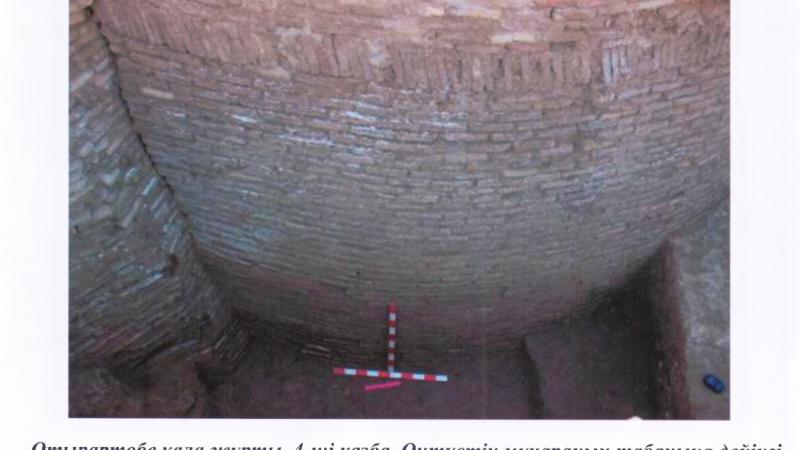
Excavations were carried out on the city wall, built in the 13th century. and existed with repairs and some restructuring until the late Middle Ages. It was erected on the remains of a pre-Mongol city wall, which is clearly dated by material from the cesspools that cut through it.
Sources
- Archaeological discoveries of 1976. М.: 1977. 608 p.