Expedition to compile a list of monuments
The expedition of the Institute of History, Archeology and Ethnography of the Academy of Sciences of the Kazakh SSR was engaged in the certification of objects and protection excavations in the Dzhambul and Lugovsky regions. About 20 monuments have been recorded, among which the most interesting are the large Usun burial ground and two mounds “with a mustache” (Dzhambul district), as well as the Tulegen burial ground, consisting of several hundred mounds, layouts and enclosures of the Saka, Usun and Turkic times (6 km south of Ornek, Lugovsky district).
In the mound group Dzhatytobe on the right bank of the Talas river(10 km northeast of the town of Dzhambul), 15 Late Saka burial mounds and three ring-fences of the Usun (?) time were investigated. The mounds are 8-40 m in diameter and up to 3 m high. The mounds are earthen, with annular stone crepe. Sometimes layers of loam alternate with layers of stone. All mounds (except one) are single-grave. Large (3–5 m long), shallow pits of simple design, predominate from west to east. Found one catacomb. All graves have been robbed. The inventory is represented by fragments of ceramics, mostly circular. Among other finds, we note a gold-stamped plaque depicting a fantastic creature with the head of a predator and the body of a bird. Sites of a new type were discovered, one of which is located on the northern slope of the foothills of the Kirghiz Range in the tract Sulutor (10 km south of Ornek). The megalithic complex, stretched for 3 km, consists of numerous fences fancifully connected with each other, built, as a rule, from large granite boulders of mudflow origin. There are also relatively small fences on the territory of the complex. Three small enclosures have been excavated. The inventory consists mainly of fragments of medieval ceramics. The nature and purpose of the monuments are not entirely clear.
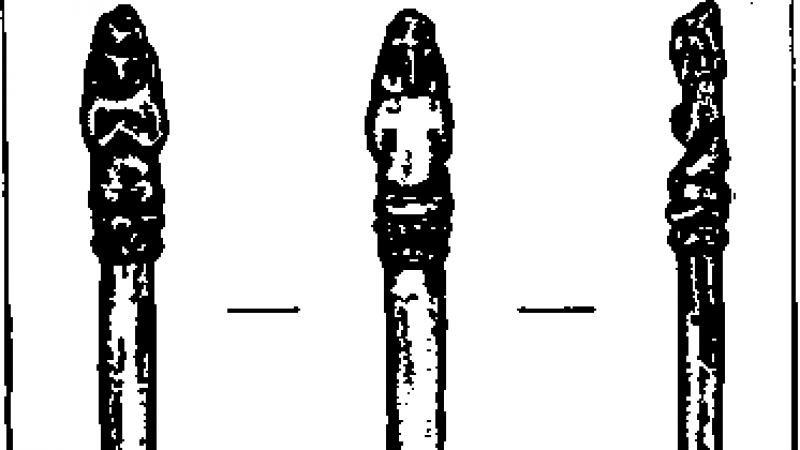
Studies of the ancient settlement of Kostobe (medieval Hamukat) were carried out. The settlement is located on the right bank of the Talas river, 15 km north of Dzhambul. The excavations have affected the city cemetery 0.5 km north of the citadel, behind the northern wall of the rabad. This is a quadrangular mound (80x80 m) with a higher (up to 5 m) western part, a “courtyard” and an entrance. The main part of the necropolis was occupied by collective burials in nauses, attached one to the other. The nauses, square and rectangular in plan, had walls made of rectangular raw bricks and, judging by the remains of the structures, were covered with box and dome vaults. 14 nauses were opened (3.3x3.4; 3.9x3.8; 3.5x3.5; 2.7x4; 2.5x3.7 m). On the floors, laid out of bricks, lay the bones buried. There was no stable direction. Usually the dead are laid with their heads towards the entrances. In nauses it was, judging by. skulls, from five to 14 burials, sometimes in two or three tiers. The nauses contain silver and copper earrings, rings with shields, protrusions, copper earrings with beads put on a wire rolled into a ring, and iron plate bracelets. Of interest are the bronze plaques depicting two opposing roosters near a tree and a mirror handle, the end of which is made in the form of a female figurine with arms crossed on the chest. The woman has almond-shaped eyes, a hooked nose, and a small-cap on her head. Frames of jugs and mugs were found.
Along with collective burials in nauses, burials of skulls, and bones in khums, heaps of bones, single burials, including one with a mug, were found.
At the cemetery, five burials were cleared, made according to the Muslim rite in grave pits lined with bricks, with a strict north-western orientation of the dead. The cemetery dates back to the 6th-9th centuries.
A survey of the settlement of Dzhankent (medieval Yangikent) and its environs was carried out. The study of the topography of Dzhankent, in particular its fortification, showed that the wall, preserved in some places to a height of up to 3 m, made of rows of pakhsa blocks with interlayers of reeds between them, was placed on an ash pan, which had accumulated on the edge of the settlement and, apparently, overwhelmed the wall earlier time. The construction of the late fence dates back to the beginning of the 13th century. To the north of the settlement, the Myntobe burial ground was discovered, consisting of hundreds of mounds. Obviously, people were buried here from the first centuries of our era. In the 13th-14th centuries, there were mausoleums lined with majolica tiles and bricks. One mausoleum belongs to the 18th century.
The site of ancient settlement Ordakent near the city of Yanykurgan was surveyed. A burial ground was discovered next to it, dating, like the site itself, to the first half of the 1st millennium AD.
Work continued on the site of Kuyruktobe in the Otrar oasis. Excavations of the citadel have revealed a castle-type architecture with a front hall in the center (15X0.5 m). An entrance 1.5 m wide has been preserved in the southwestern corner. Sufas 1.2 m wide and 0.2 m high have been built along all the walls. Found two spearheads. Pottery is represented by jugs, mugs with one or two serrated handles. Vessels covered with dark red, cherry and black engobe date back to the 7th-8th centuries.
Excavations in the northwestern section of the citadel have yielded material from an earlier time. Pottery is represented by stucco hums, cauldrons, torts, jugs, and mugs. Of particular interest are water-bearing jugs, which are characterized by a combination of brown engobe and corrugated throats. On the body of some jugs there are traced tamga-shaped signs in the form of rhombuses and squares. These new ceramic complexes date back to the 3rd-6th centuries.
A three-room house has been cleared in Shahristan. The dwelling has dimensions of 7x6 m. The entrance is tambour-shaped. Sufas 1 m wide and 0.2 m high were built along the southern and western walls. In the center, on the floor, there was a hearth in the form of a platform with a rim (1.5x1 m).
The front part is decorated with two rounded protrusions. Another hearth (1x0.2 m) is attached to the northeastern wall. Pottery includes standard type jugs, bowls, bowls, lamps. All vessels are made on a potter's wheel. Three periods of the life of the house have been established: 9th-10th centuries; 11th-12th centuries; end of the 13th century. Interesting from the finds of the 11th-12th centuries is the throat of an Aquarius, the drain of which is shaped like a demon's head with horns. By the middle of the 13th century, there was a hoard of copper dirhams minted locally.
Sources
- Archaeological discoveries of 1986 г. М.: 1988. 544 с. ISBN 5-02-009406-4