Petroglyphs of Dzhungar Alatau
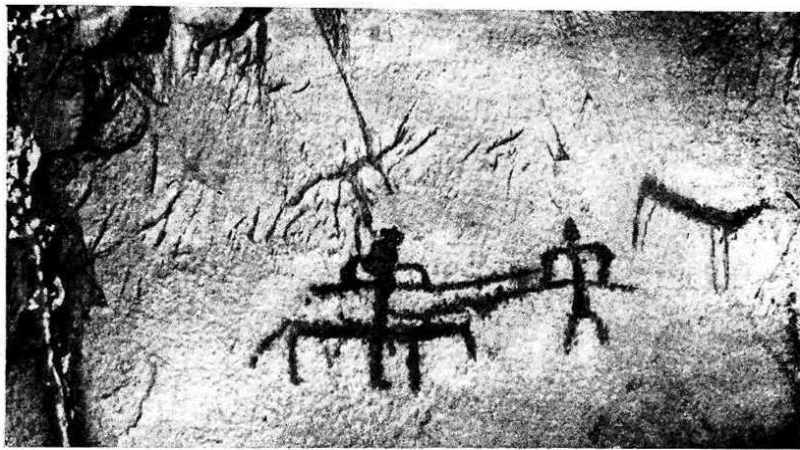
The Semirechie detachment of the Institute of History, Archeology, and Ethnography of the Academy of Sciences of the Kazakh SSR investigated the rock carvings of the Dzhungar Alatau (Kapal district of Taldy-Kurgan region). In the Kara-Kungei, Bayan-Zhurek, and Myn-Shunkur mountains, hundreds of rock carvings were found, including multi-figured compositions and individual images, embossed or scratched with stone and metal tools.
In the Kara-Kungei mountains, significant accumulations of petroglyphs are located on the heights dominating the pass leading to the Dzhansugurov village. The plots of engravings are varied. The oldest of them may date back to the Stone Age. These are images of primitive bulls, rhinos (?), horses, birds, deer, goats, predators. Note the composition with pictures of the tree of life, a snake, zigzags, and an “ornament” similar to fish scales. There are numerous images related to the Eneolithic and Bronze Ages: chains of goats with steeply curved horns, archery hunting for argali, solar symbols. The plots of the hunt for a giant wild bull the attack of four dogs on a cow are interesting. There are images of solar chariots, symbols in a pair of circles connected by a line on which deities stand, stretching their arms to the sides. In a different style, prominent figures of elk and deer are carved by tribes undoubtedly associated with Siberia. The Scythian-Saka era dates back to plots reminiscent of the early Scythian-Siberian style: strings of argali, goats and deer with a characteristic ornamental stylization; heraldic pairs of goats, bulls, horses; engravings depicting running bustards and crowned cranes; the motif of a winged goat; graffiti camels, wild boars and tigers. Characteristic are scenes of torment and images of a panther curled up into a ring, similar to those known from the early Saka mounds. Saka petroglyphs are rich in complex hunting, battle and ritual scenes. Men in caps, with quivers full of arrows, shoot from bows, fight with axes and acinaces, and ride horses. Later petroglyphs belong to the Turkic time. Bactrian camel figures sketchy images of goats, tamgas, and horsemen. Arabic inscriptions and graffiti of Kazakh tribes date back to the late medieval period.
On the isolated Bayan-Zhurek ridge, plots of ritual goat-headed and tailed people, a tree with anthropomorphic features, a god - the "master of animals" holding goats in his hands, a horse with a solar symbol on its back, were recorded. Turkic engravings are represented by warrior horsemen in helmets, with swords, bows, spears and banners, on horses with a mane trimmed with teeth, with a sultan and tassels. Remarkable scenes of duels mounted pikemen, accompanied by bodyguards.
Sources
- Archaeological discoveries of 1980. М.: 1981. 508 p.